




5CCT + 3 Power Levels in One Downlight: How B2B Lighting Buyers Are Cutting SKU Counts by 60% in 2026
The Real Cost of SKU Complexity in B2B Lighting
Inventory complexity is one of those problems that doesn't show up on the product spec sheet but shows up everywhere else. Three angles B2B procurement leaders consistently raise when we ship samples to them:
- Cash tied up in slow movers. A single-spec downlight that ships 50 units a quarter is — by definition — eating carrying cost. Multiply that across a 12-SKU catalog and you're typically sitting on 25–35% of inventory that contributes less than 5% of revenue.
- MOQ friction on re-orders. Every additional SKU means another PO to your supplier, another freight consolidation effort, and another set of forecasts to get wrong. Distributors handling 6–12 monthly reorders from China know exactly how this adds up.
- Project mix uncertainty. A hotel project might need 4000K in the corridors and 2700K in the rooms. A residential developer might order 50% warm white on one phase and 50% cool white on the next. With single-spec SKUs, you either over-commit on one CCT and under-stock the other, or you pay for two separate POs — and hope the timing aligns.
The wholesale lighting market has been moving toward SKU consolidation for at least five years. Adjustable downlights finally crossed the line where that consolidation is operationally viable for serious B2B programs — not just a marketing claim.
Why Adjustable Downlights Became the 2026 B2B Default
Three macro trends pushed adjustable CCT and switchable wattage from "interesting option" to "expected standard" in distributor catalogs across Europe, the Middle East, Australia, and increasingly North America.
1. Project specifications keep drifting warmer
Energy codes across the EU and several U.S. states have quietly tightened CCT ceilings. The old "everything is 6000K" spec is mostly gone from commercial projects. Hotels, restaurants, and high-end residential now default to 2700K or 3000K, often with warm-dim options. Distributors carrying fixed-CCT inventory get caught mid-spec and end up discounting or writing off.
2. Lighting designers want flexibility at the jobsite
When a designer specifies "warm white" for a hotel lobby and the contractor installs the fixtures three months later, interior finishes have often shifted warmer. With an adjustable CCT fixture, the installer flips a switch — no reorder, no swap, no wasted installation cost.
3. Inventory capital is finally expensive enough to matter
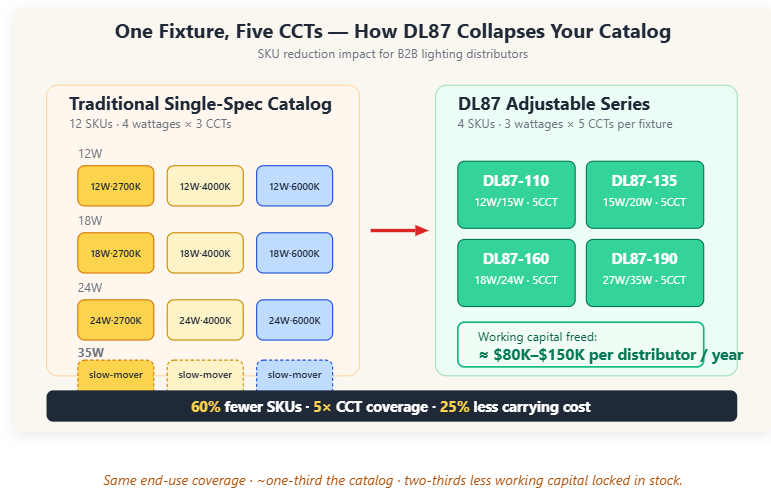
With interest rates where they are in 2026, distributors are paying real money for their inventory. A 60% SKU reduction isn't a tidiness play — it's a working capital play. Four base SKUs instead of twelve means roughly 50–60% less capital locked in stock, faster turnover, and dramatically less obsolete-inventory write-down at year-end.
Product Spotlight — DL87 Series, Built for B2B Programs
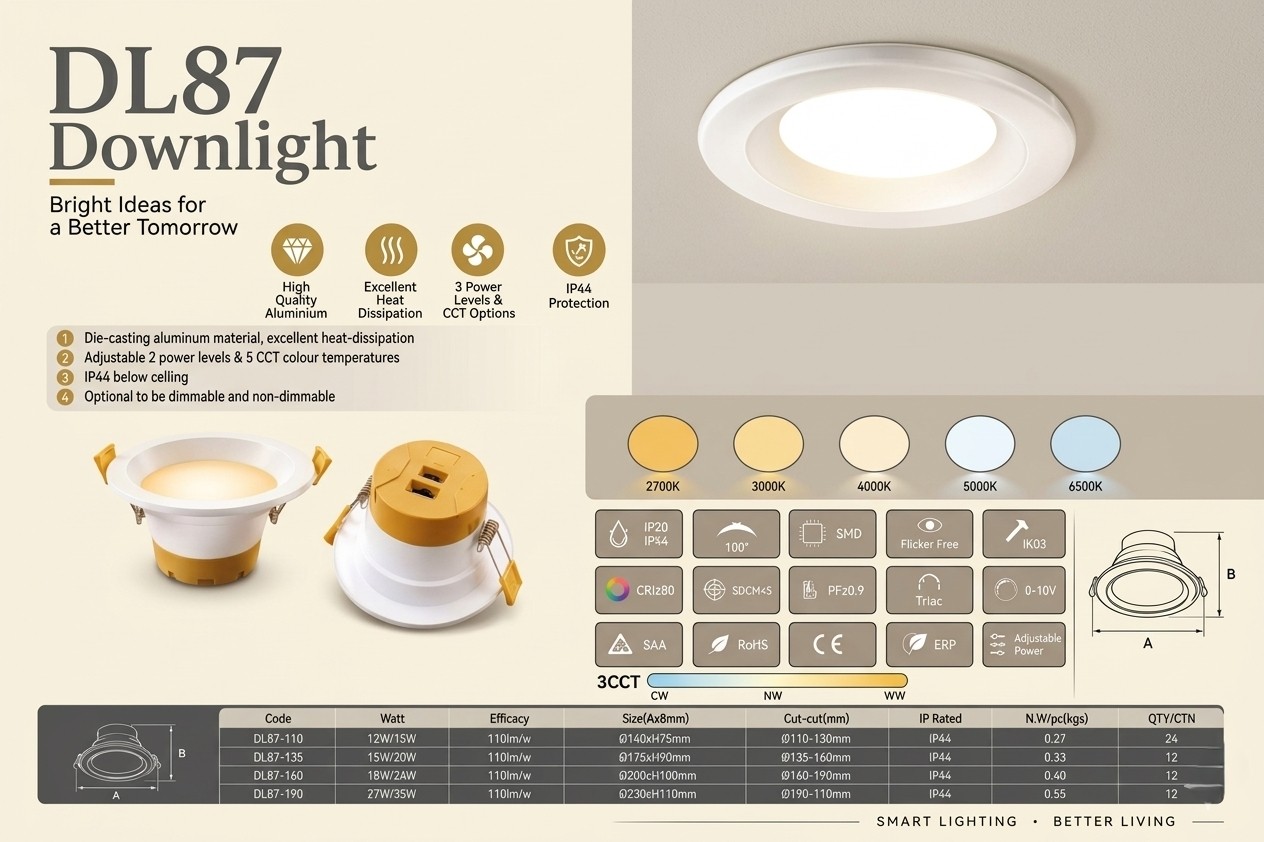
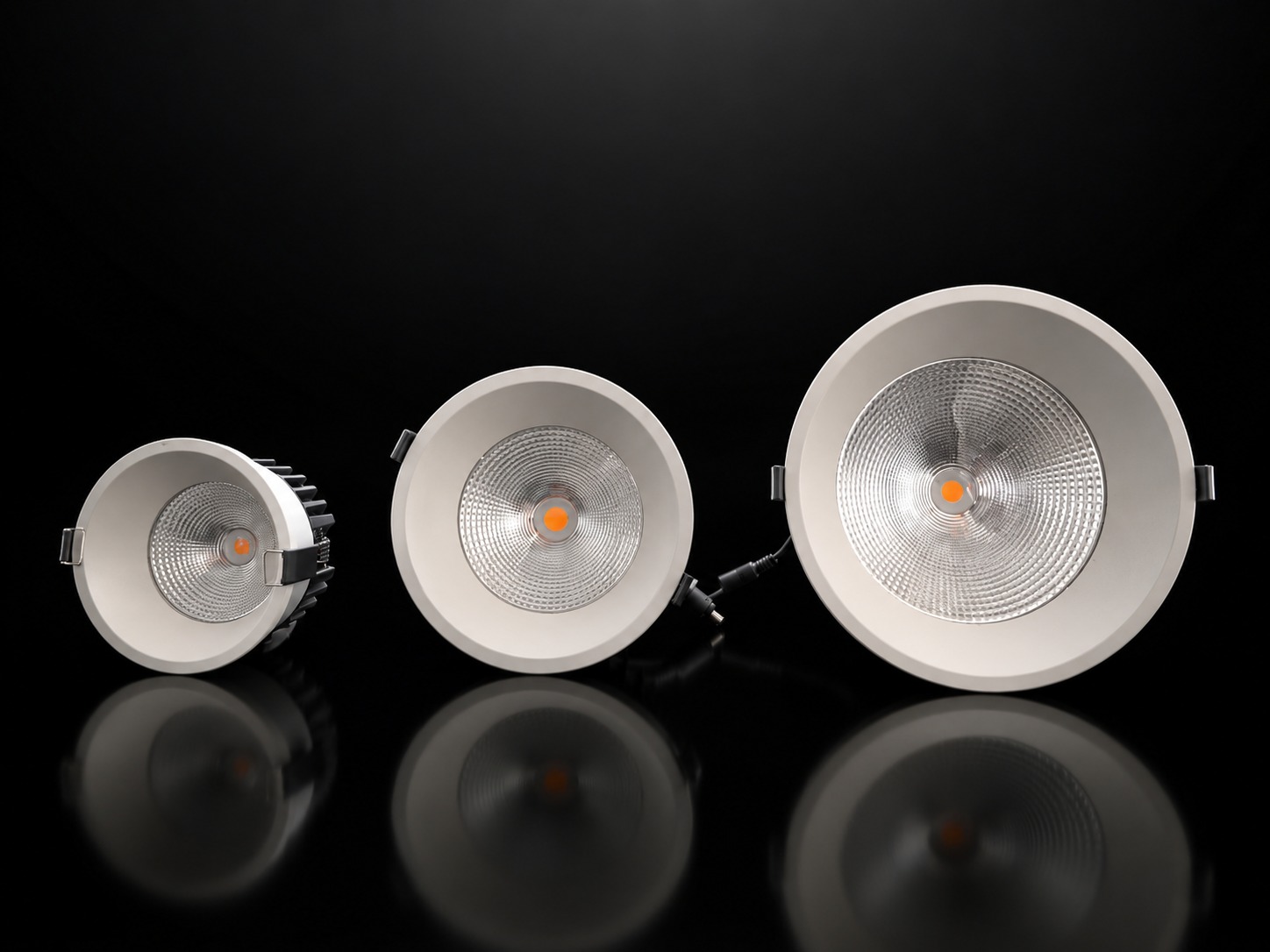
The DL87 series is the type of spec sheet that B2B procurement teams can actually build a program around. Four base SKUs — DL87-110, DL87-135, DL87-160, DL87-190 — cover roughly the full range of cut-outs you'd need across residential, hospitality, and commercial projects, from 110mm up to 190mm, with no overlap.
| Feature | Specification |
|---|---|
| Wattage options (per SKU) | 3 switchable levels — 12W/15W, 15W/20W, 18W/24W, 27W/35W |
| Efficacy | 110 lm/W |
| CCT options | 5 selectable: 2700K / 3000K / 4000K / 5000K / 6500K |
| Beam angle | 100° |
| IP rating | IP44 below ceiling |
| CRI | >80 |
| Power factor | ≥0.9 |
| Dimmable options | Triac / 0-10V optional |
| Flicker | Flicker-free driver |
| Surge / impact | IK03 |
| Certifications | CE · RoHS · ERP · SAA |
| Housing | Die-cast aluminum (excellent heat dissipation) |
What makes it procurement-friendly
Five CCTs in one fixture, switch on the back
A typical hotel project might use the same SKU in three different CCTs across guest rooms, corridors, and back-of-house — handled at install time instead of PO time. The same SKU serves both a Saudi residential developer who spec'd 4000K and an Australian boutique hotel that wants 2700K.
Two switchable wattages per SKU
Instead of carrying a 12W and a 15W separately, buyers carry one fixture that does both. For distributors with mixed end-customers, this halves the wattage-related SKU count immediately.
Die-cast aluminum housing
In a B2B spec, housing material is a proxy for product longevity. Die-cast aluminum outperforms sheet metal on heat dissipation, which directly translates into lumen maintenance over the 25,000–50,000-hour rated life. For project buyers, this is the difference between a warranty claim in year three and a clean shipping record.
IP44 below the ceiling
Buyers for kitchen, bathroom, and covered-outdoor projects get a true moisture-protected solution without paying for a higher-IP fixture they don't need.
Triac and 0-10V dimming options
Most B2B accounts in Europe and the U.S. have a default dimming protocol. Having both options within one product family — without forcing a separate SKU — removes a frequent RFP friction point.
Multi-market certifications (CE / RoHS / ERP / SAA)
One product line covers EU, Middle East, and Australian projects. For distributors selling into two or more of those regions, this is the certification stack they actually want.
B2B Procurement Checklist — What to Verify Before Committing
Adjustable downlights are not all the same. Before a buyer commits a full container or enters a quarterly program, these are the items experienced procurement teams always verify:
- The CCT switch is genuine, not just labelled. Confirm the fixture has a real, accessible selector — usually a slide switch on the driver or back of the housing — that toggles between all five options. Avoid fixtures where "5CCT" is a marketing phrase and only two options are actually selectable.
- Wattage switching is independent of CCT switching. Some fixtures force you into a fixed wattage-CCT combination. The point of an adjustable program is to break that link. Verify both can be set independently.
- CRI is consistent across all CCTs. Cheap adjustable fixtures sometimes drop CRI at the warmer end. Ask for test reports across the full CCT range, not just at 4000K.
- Driver brand is documented. A high-quality LED downlight with a no-name driver is a project liability. Look for known driver brands (Lifud, Eaglerise, BOKE, etc.) and confirm the brand on the BOM, not just on the marketing sheet.
- Flicker-free is tested, not claimed. Flicker is a deal-breaker for hospitality and office projects and increasingly regulated. Request test reports (IEEE 1789 / NEMA 77) rather than accepting the spec sheet.
- Certifications match your target market. CE alone is not enough for Australia (SAA) or for ERP labelling in the EU. Map the certification stack to your specific sales regions before signing a PO.
- Packaging is project-friendly. For buyers handling multiple SKUs in shared warehouses, clear carton labelling with CCT, wattage, cut-out size, and color matters more than it sounds. Confirm packaging supports your fulfillment workflow.
Procurement reality check: The cheapest adjustable downlight in your inbox is rarely the cheapest program over 12 months. Every warranty claim, every slow-moving SKU, every freight split on a low-volume re-order is a hidden cost that disappears when you consolidate your catalog with a well-built adjustable fixture.
How to Source Bulk Adjustable Downlights from China in 2026
A typical B2B sourcing cycle for an adjustable downlight program runs in six steps:
Step 1 — Shortlist 2–3 manufacturers
Based on certifications, sample quality, and minimum order quantity. Send a single RFQ covering all four base SKUs at target pricing. Ask for an EU-mix or mixed-SKU quote — most adjustable programs benefit from container consolidation.
Step 2 — Order evaluation samples
3–5 pieces per SKU, often free or near-cost. Test across all CCTs at all wattages. Run a CCT verification with a spectrometer if your program requires it. Cycle them thermally for at least 72 hours.
Step 3 — Negotiate tiered pricing
Clear breakpoints at 500 / 1,000 / 3,000 / 5,000 pieces. Ask about mixed-SKU container pricing — most factories will let you combine the four base SKUs in one container, which is exactly the operational benefit of an adjustable program.
Step 4 — Lock in packaging and labelling before production
This is the cheapest time to customize, and the most expensive time to change. Carton labels should clearly state the selectable CCT, wattage step, cut-out size, and color.
Step 5 — Pilot order 500–1,000 pieces
Run them through real distribution. Get your customers' feedback on the switch position, the CCT labelling, and the installation experience. Adjust before scaling.
Step 6 — Quarterly re-orders based on sales velocity
With four base SKUs instead of twelve, your reorder cycle gets simpler and your working capital stays leaner.
Conclusion: The 2026 B2B Lighting Buyer in Brief
The DL87 is one example of a broader 2026 pattern in commercial LED lighting: fixtures designed for procurement efficiency, not just end-user performance. Adjustable CCT and adjustable wattage have both crossed the line from "interesting option" to "expected default" in distributor catalogs across Europe, the Middle East, Australia, and increasingly North America.
For B2B lighting buyers, the question is no longer whether to run an adjustable downlight program. It's how to run one well — which manufacturer, which SKUs, which certifications, and which internal sales story explains the value of "one fixture, five CCTs" to a hotel or developer who's used to spec'ing fixed-CCT SKUs.
If you're evaluating a 2026 downlight program — or running adjustable downlights and looking for a more reliable source — the DL87 series is built for that conversation.